
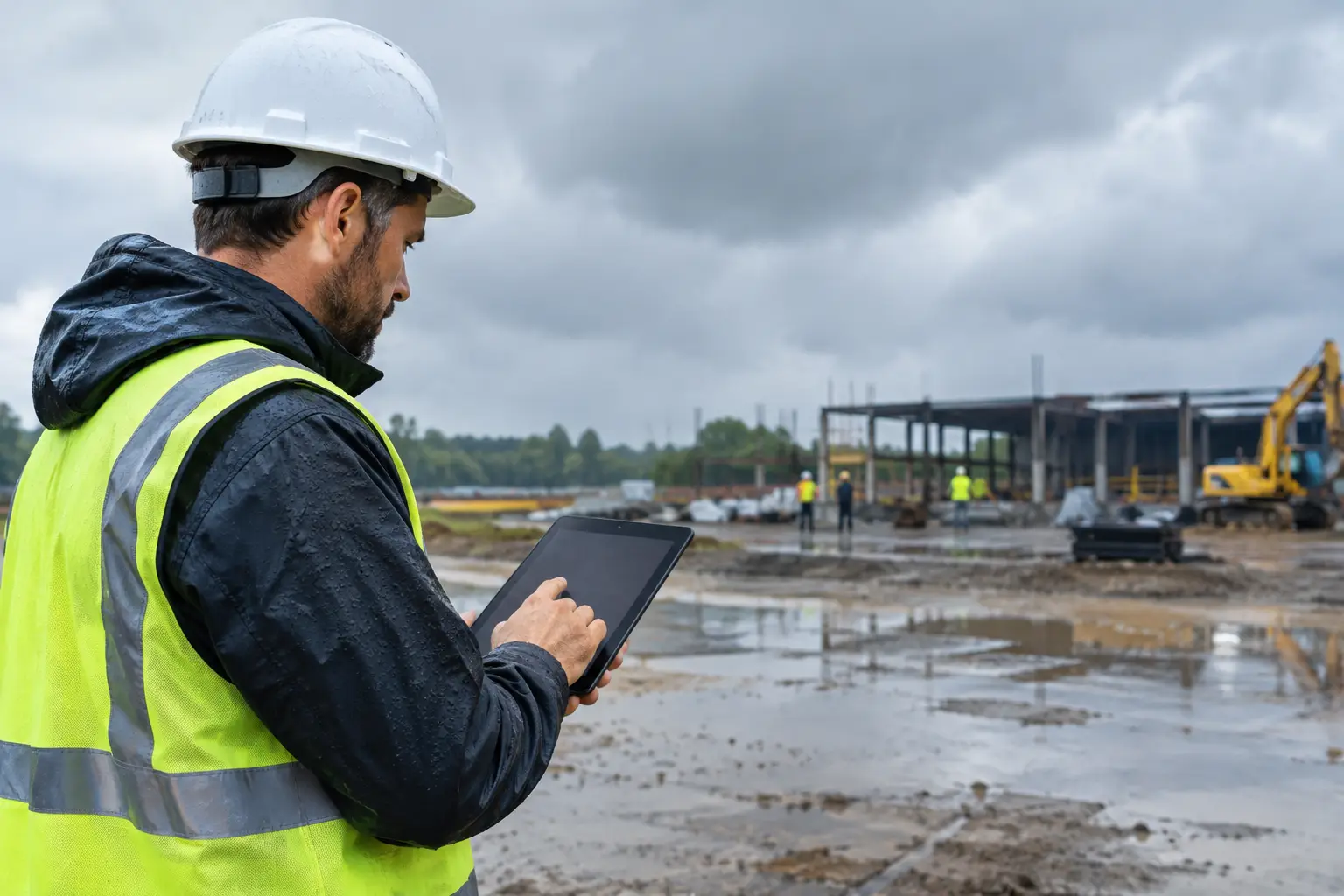
A rain day does not automatically equal a compensable delay. But a missing or vague daily log can turn a real weather impact into an argument nobody can prove six months later. Knowing how to document weather delays means capturing what happened, when it happened, what work it stopped, and what your team did next – while the conditions are still on the jobsite.
For a superintendent in wet boots, the goal is not to write a weather report. The goal is one accountable record that ties field conditions to actual schedule impact.
Start the Record When Conditions Affect Work
Do not wait until the end of the week to reconstruct a storm from memory. By then, the rain has stopped, crews have moved on, and the details that matter are buried in texts, photos, and conversations.
Document the delay the same day, ideally when the conditions first affect work. Record the date, project, location, and the time work was interrupted, slowed, or could not start. If rain began at 10:15 a.m. but concrete placement had already been canceled based on standing water and the forecast, say that plainly. The record should show the sequence of events, not just a weather label.
A useful entry distinguishes between three things: observed conditions, operational impact, and the response. For example, heavy rain may be the observed condition. Inaccessible excavation, unsafe lift operation, or inability to place exterior sheathing is the operational impact. Reassigning crews, protecting materials, pumping water, or rescheduling a pour is the response.
That distinction matters. Weather alone does not explain why a critical activity moved. Field facts do.
What a Defensible Weather Delay Record Includes
A complete record should read like a person who was there wrote it – because one did. It should be specific enough for a project manager, owner, or future reviewer to understand the situation without guessing.
Include the weather conditions and their timing. Note rainfall, lightning, high wind, snow, freezing temperatures, mud, standing water, or poor visibility as they affected the work. You do not need to turn your daily log into a meteorological study. If you have verified weather data available, it can support the record, but the field report should focus on what crews actually encountered.
Then identify the affected work. Name the activity, area, trade, and crew where possible. General statements such as work delayed due to rain are weak because they leave too many questions open. A stronger entry identifies that the framing crew could not install roof sheathing on Building B due to sustained high winds, or that earthwork at the north parking area stopped because the subgrade became saturated and hauling equipment could not operate safely.
Document labor and equipment impact. Record how many workers were affected, whether they were sent home, reassigned, placed on standby, or moved to productive interior work. Note equipment that sat idle or could not be operated safely. This is not about inflating a claim. It is about showing the real cost and operational consequence of the event.
Finally, document mitigation. Owners and project teams want to know what happened next. Did the team cover materials, set pumps, adjust sequencing, work in another area, add protection, or plan recovery work? A record that shows reasonable mitigation is more credible than one that simply says the day was lost.
How to Document Weather Delays Without Guesswork
Use exact times whenever they change the story. A two-hour weather interruption is different from a full lost day, and a storm that hits after a concrete pour is different from one that prevents the pour from starting.
Be careful with cause and effect. Do not state that a storm caused a three-day schedule delay on day one unless that outcome is already clear. State the current impact: excavation suspended at 11:00 a.m.; site access remains unsuitable; work will be reassessed at morning startup. Update the next day with what changed. This creates a clean, credible timeline instead of a record that overreaches.
Photos help, but photos without context create their own problem. A picture of pooled water is useful when the daily report identifies the location, time, affected operation, and why the condition prevented work. Capture wide shots that establish the area, then closer photos of the specific condition. If material damage, washout, or unsafe access is involved, photograph that too.
The same rule applies to forecasts. A forecast can inform a decision to protect work or reschedule an activity. It does not replace an account of actual conditions. Record both when relevant: the forecast prompted the crew to secure materials, and the observed storm later prevented exterior work from proceeding.
Keep Subcontractor Reports in the Same Timeline
Weather disputes get messy when the GC has one version, each subcontractor has another, and nobody submitted a report until the pay application is due. A subcontractor may have a legitimate impact that never appears in the GC daily log. Or a subcontractor may report a lost day when other work areas remained available.
Ask subcontractor foremen to document their own conditions, affected scope, labor count, and mitigation on the day of the event. Their report should not replace the GC record. It should support it with trade-level facts.
This is especially useful on active sites with English- and Spanish-speaking crews. The person closest to the work should be able to report what happened in the language they use on site. A bilingual record is better than a late translation based on incomplete notes. The standard stays the same: clear facts, submitted promptly, tied to the work performed or stopped.
FieldLog lets GC team members and subcontractors speak their daily reports in English or Spanish, then review and submit a professional, sealed, timestamped project record. No typing in wet boots. More importantly, everyone is contributing to one project timeline rather than scattering the facts across text threads and paper logs.
Tie the Field Record to Contract Notice Requirements
Your daily report is evidence, not necessarily formal notice. Many contracts require written notice within a stated number of days, sent to a specific party, with defined information about the event and claimed impact. Missing that requirement can create trouble even when the field conditions were real.
When a weather event may affect the schedule or cost, review the contract and follow the required notice process. The daily log should support that notice by giving the project team accurate dates, times, impacted activities, labor information, photos, and mitigation details. It should not be treated as a substitute unless the contract clearly says it is.
There is also a practical judgment call. Not every passing shower deserves escalation. If crews shift to productive work and the schedule does not move, document it as a weather condition with no material delay. If critical-path work cannot proceed, site conditions remain unsafe, or recovery will require a schedule adjustment, elevate it promptly.
A Field-Ready Weather Delay Entry
A strong daily entry might read like this:
At 9:40 a.m., sustained rain created standing water in the north parking area and saturated the prepared subgrade. Sitework subcontractor suspended grading and hauling operations for safety and to avoid damaging the subgrade. Eight operators and laborers were affected; two were reassigned to erosion-control maintenance, and six were released at 11:30 a.m. GC and sitework foreman inspected the area at 3:00 p.m. Pumps were installed, inlet protection was checked, and the area will be reassessed at 6:30 a.m. tomorrow. Photos attached.
That entry does not make legal conclusions. It does not exaggerate. It gives the next reader the facts needed to understand the impact and the response.
Make the Record Hard to Question
The strongest documentation habit is simple: record the conditions before the details fade, submit the report the same day, and preserve it in a system that shows when it was created. Avoid editing a past record without a clear trail. If new information changes the assessment, add a follow-up entry rather than rewriting history.
A weather delay is rarely won or lost because someone used better wording. It is won or lost on whether the record shows what the field actually faced, what work was affected, and whether the team acted responsibly. Talk it out while the work is happening. Get the record while it still means something.
Leave a Reply